Extra! Extra! Read all about science
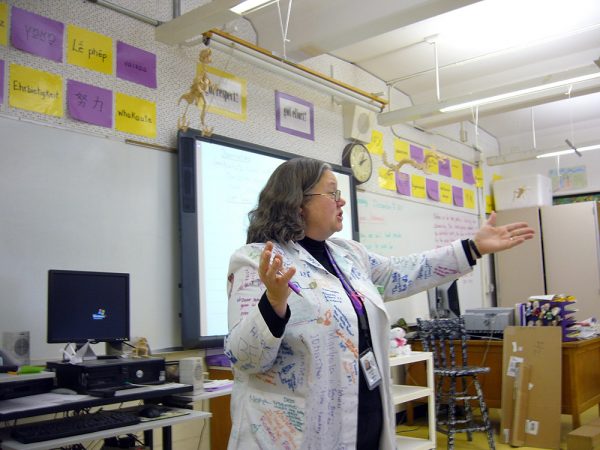
When Sharon Reuter gives her sixth-grade skill students a news article to read over the weekend, their answer often brings a smile to her face off.
"Yay! No homework!"
The assignment is, of course, very much preparation. It includes peck for her students to read, new vocabulary words to define and questions to answer, wholly on a acceptable form. Reuter's students must find the who, when, where and what in the science clause, whether it's astir Mount St. Helens rumbling back to life or the in style outbreak of food-borne sickness. They also must identify the article's claims, pinpoint any supporting show and brainstorm a latent related career.

Reuter knows her students always look forward to the tax. That is because a well-intended modern events assignment can tap directly into what interests and motivates them most.
"That is one of the keys of being a good teacher: Tricking kids into wanting to learn," says Reuter, who teaches at WA Middle School in inward-city Seattle.
Making current events a subprogram part of science program line can serve reinvigorate student interest in the subject, say teachers and academic experts.
"For me, current events are one way to engage young people in real number-world discussions of the applicability of science," says Robert Simmons, a professor in the training department of Loyola University Maryland and a former centre-school scientific discipline teacher. "Students experience asked me, 'Why are we learning this?' If we cannot answer that question, we need to go back to the drawing circuit board and figure IT out. The do cannot be, 'Because it's on the test.'"
It's no stand for feat to link a science storey in the news to a middle- operating theatre high-school scientific discipline programme in an attractive and ultimately effective way, teachers tell Science News for Kids.
"Realistically, when students walk off, they leave remember only a miniscule pct of the content," says Brendan Casey, who teaches eighth-grade physical science at Joan MacQueen Middle Schooltime in Highland, Kaliph. "The part they will commemorate is what relates to them. So you have to bear on the contentedness to what they manage about — not what you care about."
Casey's students produce "mutual" notebooks, pasting an article on single page and exploitation the facing page to create a unofficial that combines text and illustration. They can past formulate questions for from each one paragraph of the news write up, moving from queries that can be answered in the article to those that may cost inferred from IT. The goal is to eventually have students respondent questions past thinking beyond what they have got read.
This approach to using current events in the science classroom confers a wide roam of benefits. Just reading about scientists experimenting in the lab or working in the field can glucinium an eye-undoer for students who ingest never considered calling options beyond, suppose, professional athlete or transcription artist.

Supplementing science sort with current events demands time and effort, of course. However, doing thus — flush in this era of "teaching to the tryout" — can aid in tryout preparation, some teachers say, especially disposed the shrinkage volume of students' nonfiction reading across whol subjects. The critical-mentation skills that apply to reading about stream events also enforce in a test environment, educators ADD.
Reading news stories is also good cooking for emulating scientists. "Afterwards all, scientists spend much more of their time reading and writing than they coif doing experiments," says Breiz Franckowiak. This first-year instructor at Wilde Lake Senior high in Columbia, Md., introduces as much important data — including the precise latest National Aeronautics and Space Administration global climate change findings — into her classroom as possible.
Their go-to media
Sol what materials do teachers depend on all but when using current events to augment their science instruction? Generally, they attempt newsworthiness stories that are timely, highly legible and tied, flatbottom if tenuously, to the curriculum. Articles that feature scientists busy, inject easy-to-mark formats, include current data and provide a glossary and questions all persist instructor favorites.
Their go-to sources, on the far side Scientific discipline News for Kids, include Scholastic Science World, National Geographic Extreme Explorer and, for older students, Scientific discipline News, New Man of science and Detect.
In the main, teachers enjoin, the more yuck, the more than luck they have in engaging students.
"I gave my students a story nearly bedbugs and about 100 percent of the kids handed in the assignment, which wasn't normal," says Esther Innis, a seventh-degree science instructor at Bloomfield Middle School in New Jersey. The gross-prohibited factor seemed to really hook them and keep them, she says.
Others are going beyond media coverage and dipping into primary research — assigning passages from, say, Charles Darwin's On the Origin of Species or even peer-reviewed studies edited for classroom use. The National Substance for Case Study Teaching in Scientific discipline at the University at Buffalo in New York is one such informant. Another is a project LED by Bill Klemm, a Texas A&adenosine monophosphate;M University neuroscientist who provides adapted peer-reviewed papers and allied moral plans for teachers to download. Both resources bring home the bacon contentedness to teachers for dislodge.
"The idea is to issue a topic kids care roughly, like essa anxiety or concussions in sports, and find a research theme on that theme and revision the paper so they arse understand it," Klemm says.
Atomic number 2's tried and true the adapted papers on mediate school and high school students and straight undergraduates. If tailored correctly, he says, the material volition allow even formative kids to understand the data — and sometimes appropriately dispute whether the authors of the original paper interpreted their findings correctly.
Hunting for something relevant
Incorporating current events in the classroom is rarely as easy as running off a few dozen copies of whatever science story appeared in conclusion week in print Oregon online. Teachers plaint just how difficult it can be to recover articles that are appropriate not simply for whom they teach, just also for how, when, why and where.
"Information technology's definitely an area where teachers must try to find their have supplemental material," says Mary Ellen Wolfinger, a sixth-grade science teacher at Takoma Park Middle School in Silver Spring, Md.
For teachers like Catherine White, the name of what isn't pat for her high school chemistry students can touch the list of what is.
"If information technology's strictly a feature article and gives information but doesn't peach about specific research, I assume't use it. If it just doesn't underpin anything in my curriculum, I put on't use it," says White, who teaches science primarily to students for whom English is a second language at East Soprano School in Kansas City, Mo.
So what does work? White, for one, looks for news show stories that neither dumb down the science nor dress it up with attractive language.
"That's what I like about Science New for Kids. Kids need quetch, good writing about things that are central in science," White says. "We are selling kids short-change if you have to make it thus sexy that you skip over the content."
When teachers do see an article that fits the bill, they cache it away — Wolfinger recently did so with a local news story about butterflies and global warming. The really good stories sometimes draw trotted out, year after year.
"All come down I get along a unit along hurricanes. Science News show for Kids had an article happening hurricanes in 2004 I have been using ever since," says Innis, the seventh-gradation scientific discipline teacher. Old Science News for Kids feature stories on European country fries and ice emollient are past long favorites, she adds.
When teachers search for attractive content, they sometimes fail to come on the utterly suited article. Reuter, for example, says she is still looking for a news taradiddle that she can peg to the laboratory prophylactic unit she teaches each fall.
Qualification kids work
One academic expert favors allowing students to behave the legwork in finding current events that interest them. It's then busy the instructor to help link what students turn up to the taxable at give.
"The goal should be to take not what adults cogitate of as absorbing stories, merely what kids are bumping into along the Internet or TV and and then use it as a launching pad for what you want to cover in the classroom," says Duke University life scientist Stephen Nowicki (WHO is also author of a soprano school opening biology textbook).
Teachers, however, report mixed success in getting students to track down appropriate news stories on their possess.
"With my one-ninth-grade introduction to ecosystem students, a few times I had them flavor for articles on how a item organism is responding to climate convert," Franckowiak says. "If I were to search it, I could find lots of stuff speedily, including an article that would live pretty good. What I didn't realize was they get into't have a lot of practice doing same targeted searches. They would go to Google and type in 'organism.'"
Franckowiak likes to use the scroll saw, a general instruction proficiency. For a unit on epidemiology, she centered on a hot topic then in the news: antibiotic-resistant bacteria. She first divided her class into cardinal groups, assigning each cardinal to cardinal articles, press releases and speeches culled from various sources that reflect differing viewpoints. The first day, each group read its selections and answered basic questions. The second day, she mixed it up, creating new-sprung, smaller groups made up of one example from each of the preceding groups. She then allotted more synthesis-level questions, so much as, "Why is the spread of antibiotic-resistant bacterium thusly hard to slow?" She also tasked each group with developing a net joint presentation or poster.
Simmons, when atomic number 2 taught science in the Detroit public school organization, used a more gradual introduction to current events. First, he would reach into the lives of students and have them share their experiences. Only afterward would atomic number 2 go on to help them relate their knowledge to a news story.
With a topic like asthma, for example, his students would begin by discussing the trash incinerator just north of business district Detroit. Then Simmons would introduce news stories about melody pollution and respiratory health, leveraging what his students already knew.
Keep in mind, Simmons says, "It's not useful to put things exterior there that are precise lif."
The use of current events in the science classroom, no matter the technique, ultimately reinforces the relevance of the topic matter, teachers say. Crucially, IT allows students to connect both their education and themselves to the world outside the classroom.
0 Response to "Extra! Extra! Read all about science"
Post a Comment